Coopers and marriage equality

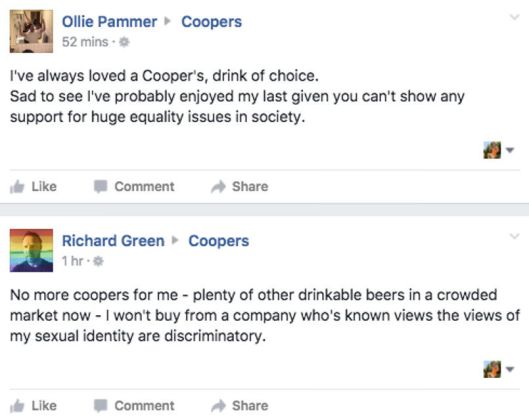
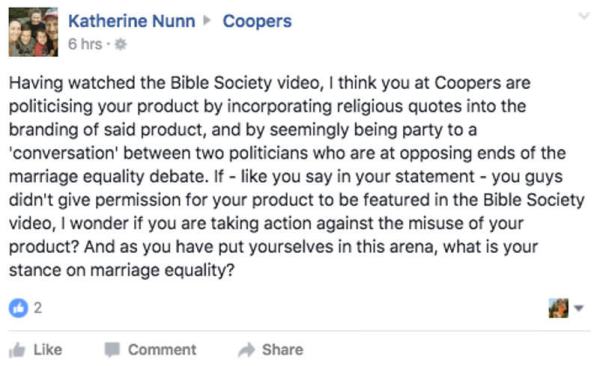
In 2014 Coopers faced some flack for their Halal accreditation for their malt extract products. There were a lot of angry Coopers customers who didn’t appreciate how their favourite beer was paying a religious tax. Now Coopers are facing a massive social media backlash and boycott after this ‘Keeping it Light’ video by the Bible Society has been released.

coopers-805x640

It features liberal politicians Andrew Hastie (an agnostic same sex marriage supporter) and Tim Winton (a christian who does not support same sex marriage) hanging out in a parliament cafe having a chinwag.

Coopers has just released a special beer to mark the 200th anniversary of the the Bible Society of Australia.  They will release 10,000 cartons of light beer with Bible verses printed on the outside. This charity claims they are not anti same sex marriage and that Coopers had no idea the video was being made.

Pubs have responded by refusing to sell Coopers and throwing out all of their Coopers into rubbish bins in the laneways behind their establishment. SBS responded by making a satirical video of Coopers and mocking Christians.

Watch the video and let me know what you think.

Do you think it’s a shameful publicity stunt and is highly offensive or do you think it is as Coopers have said “a debate that needs to happen.”  Hmmm… What do you think of Coppers continual sponsorship of the Liberal party?

Bible Society Australia CEO Greg Clarke said;

“It certainly made it hard to keep it light and we really didn’t want this to be a bad reflection on Coopers. Perhaps a bit of naivety on our part the way that we did the video. The light-hearted nature got the better of us. There was no sponsorship arrangement at all with Coopers.”

Coopers have always been a Christian company and supporting multiple charities. They’ve sponsored LGBTIAQ+ festivals in the past and haven’t explicitly stated they’re anti-gay marriage. However they haven’t come out against the video either. Edit-they’ve just come out and apologised.

coopers-2-805x489


How is consent like a cup of tea?


How is consent like a cup of tea and how did the Brits managed to turn it into an eduational video?
Check out this wonderful video from the Thames Valley Police in England for their #consent is everything campaign.  It uses the metaphor of making a cup of tea to explain sexual consent.

While the law is more complex than this video it’s still a very helpful video to explain consent and it is very engaging.  There’s been some pretty nasty consent education campaigns in the past that have blamed victims so I’m so happy to see something entertaining and simple to raise awareness about this very important issue.

The narrator speaks over animated stick figures,

“If you say ‘Hey, would you like a cup of tea?’ and they’re like, ‘Uh, you know, I’m not really sure,’ then you can make them a cup of tea, or not, but be aware that that they might not drink it.  And if they don’t drink it, then—and this is the important bit—don’t make them drink it. Just because you made it doesn’t mean you’re entitled to watch them drink it. And if they say, ‘No, thank you’, then don’t make them tea. At all.”

“If they’re unconscious, don’t make them tea. Unconscious people don’t want tea, and they can’t answer the question, ‘Do you want tea?’ Because they’re unconscious.”

“You should just put the tea down, make sure the unconscious person is safe, and—this is the important part again—don’t make them drink the tea.”

A recent study revealed that 1 in 5 women and 1 in 20 men had been sexually assaulted whilst at university. We desperately need good sexual education at schools that explain that you need “affirmative, conscious and voluntary agreement” before starting any sexual activity. Consent means the people involved must be actively saying yes much more than the previous “no means no” model.

There is so much confusion out there about what consent actually means. A lot of us received no education about consent at all.  This can lead to many damaging situations where consent is ASSUMED when it was never given at all.

Survivors of sexual assault aswell as dealing with societal shame, stigma and victim blaming can be very confused about past events and struggle to understand clearly whether it was consensual or not. This can lead to years of emotional pain and anguish.

It’s important to remember that it’s never okay for someone to force or pressure you to have sex.

Survivors can end up internalising shame about experiences that happened  when they were younger that they weren’t sure whether they were consensual or not. It’s this burden that survivors can carry from their childhood or teenage years well into their adulthood. Here’s what some survivors have said.

Maybe it was my fault? I never explicitly said no as such… I didn’t run away…. I just lay there….. I thought that’s what I was meant to do….. I was too scared to say no……   I was so drunk I didn’t know what was happening…..  S/he was my boy/girlfriend so I didn’t think I could say no…..Isn’t that what you have to do at the end of dates?  They pressured me… I felt I had to give in..


The law says that silence doesn’t equal consent. Lack of protest or response doesn’t equal consent. You can withdraw consent at any time and consent isn’t guarranteed just because people have had sex in the past.

The new affirmative-consent movement is trying to get rid of all the layers of ambiguity and assumptions. Sometimes someone might be too scared to say no and feel pressured. They might say, “ok” or “fine.” This isn’t consent.

Detective Chief Inspector Justin Fletcher explains,

“The law is very clear. Sex without consent is rape. Awareness of what sexual consent means and how to get it is vital.

If you can understand how completely ludicrous it is to force people to have tea when they don’t want tea, and you are able to understand when people don’t want tea, then how hard is it to understand when it comes to sex? Whether it’s tea or sex, consent is everything.”

Are you dating a sexual narcissist?

2ed0bc3ecc5a75c8cac38ee581fd67f1

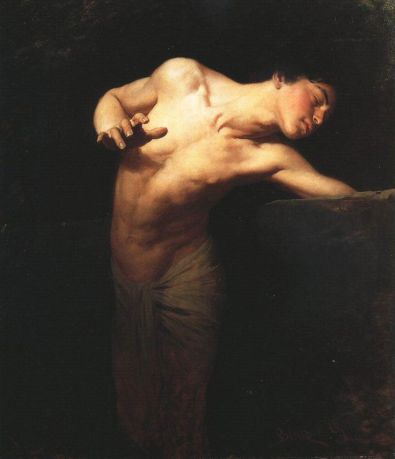
Narcissus was a young handsome man who fell in love with his reflection whilst gazing into a pool. In Greek mythology Narcissus was so dam sexy that “legions of lusty men and bevies of girls” wanted him. He was cursed to stay staring at his reflection as a punishment from the avenging goddess Nemesis for rejecting the love of the nymph Echo. Narcissus pined away over his reflection until he died.

Narcissists are  incapable of truly loving others because they only want others to reflect and prop up their own image. This isn’t love.

Freud defined narcissism as the channeling of the libido energy towards oneself.

Narcissists are very effective at short term mating but struggle in long term, committed relationships. Emotional intimacy and physical pleasure are essential human needs but narcissists avoid intimacy.

Narcissism is characterised by; superiority, entitlement and grandiosity, little empathy, interpersonally exploiting others, unrealistic positive self view, self focus and lack of care for others.

Narcissists prefer shorter affairs over long term relationships and are less faithful, emotionally intimate and committed. Narcissists are less interested in maintaining current relationships because they think options outside of their relationships are more appealing.

john_william_waterhouse_-_echo_and_narcissus_-_google_art_project

So, what is a sexual narcissist?

Sexual narcissists express general narcissistic traits within the realm of sex and relationships.

Men or women can be sexual narcissists but the research shows they are overwhelmingly men.

Traits of sexual narcissism include;
-Sense of sexual entitlement
-Use words like “power” and “dominance” in the context of sex

-Need to control sexual scenarios.
-Always in control of when and how the couple has sex
-See sex as means to a physical end rather than a way of strengthening an emotional connection

-Show an inability to experience emotional closeness and intimacy in a relationship
-Places sexuality above that of partner
-May have very chauvinistic, traditional ideas about female sexuality and gender roles
-Approach new relationships with bottomless energy and then quickly get bored and sexually unsatisfied.
-Can’t integrate sex and intimacy
-Are especially sensitive to sexual comparisons with others
-Make themselves feel better about themselves by comparing their sexual life with people who might be having less sex or less sexually satisfying lives
-Blame their partners for their sexual dissatisfaction
-Male sexual narcissists are likely to be sexually aggressive, abusive and/or cheat on their partners

-Might be more focussed on their sexual “performance” than your pleasure.
-View partners as “things” that can fulfil their needs like an appliance might rather than as a fully functional human.


A sexual narcissist has an intimacy disorder. They can’t actually give or receive true intimacy in a relationship because of his or her dysfunctional relationship ideas, insecurity, lack of self responsibility or low self esteem.

Underneath all the narcissists bravado or contempt and sneering for others there can be a very fragile sense of self that needs constant validation. 
Narcissists can be terrified of showing their truly vulnerable selves and use all manner of things to block intimacy.

In my next blog- I’ll explore how I work with couples where one of them is a sexual narcissist.

Cat O Dowd

Sex Therapist   Couples Counsellor  Art Psychotherapist

www.creativesexpression.com

50 shades of stalking, control and abuse

16508757_1101151540007057_1484820456422847537_n

Stalking and tracking someone’s phone is not BDSM and far from a healthy relationship. It’s illegal and abusive.
This is about abuse, intimidation and control.

When manipulative and controlling jerk Christian has met Anastasia only three times he turns up outside her house but she never gave him her address. He also finds out where she works and turns up unannounced. He turns up unannounced at her mothers house hundreds of miles away when she goes there to visit. This is called stalking and is abuse.

Control freak Christian buys the company Anastasia works for so he can have complete control over her, has nonconsensual sex with her ignoring her “no.” Where is the healthy consent in this movie? Anastasia often goes along with sexual acts with Christian because she’s too shy to speak up or too scared to lose him and so goes along with his wishes.

There are kinky events that aren’t erotic play but more like emotional bargaining. Anastasia feels like she has to “put up with it” because she’s terrified of what he will do to her if she doesn’t.

He micromanages her life, cuts her off from her friends and family, dictates what she should eat and what exercise she should do.
He “love bombs” her with expensive gifts, deposits tens of thousands of dollars into her bank account but won’t tell her how he got her bank account details, disregards her requests for space, limits, safe words and boundaries, has double standards and rules for her but not for him, yells at her, pressures, badgers, gives the silent treatment and emotionally blackmails her and intimidates and threatens her to get his way, says her body is his and dictates what contraception she should use and makes her go to his gynaecologist to ensure she does with her body what he wants.

How people cannot see that Christian is an abusive bully is shocking. He maintains control over Anastasia through intimidation.

It’s not romantic that he’s extremely possessive of her when they’ve just met and not even a couple.

It’s not love when he tracks her mobile phone to stalk her and come and pick her up when she’s out with her friends. She doesn’t want him to come get her and he turns up and demands she go home. This is abuse.

There’s a big difference between wanting to explore power exchanges with your partner and wanting to use power to manipulate and control them.

After she accidentally forgot to call him once he said he wanted to hurt her.

The book also pathologises BDSM. Christian says he only likes it because of his terrible childhood and later in the books he “gets over” those desires with the help of a therapist. Umm. As a kink friendly therapist I was shocked to read about his being “cured” of his kinky desires. The DSM does not list BDSM as a pathology.

Just because the media glorifies and romanticises abusive relationships it’s important to remember the following…

Intimidation is not love. Possessiveness is a sign of control not romance. You have the right to walk away from a relationship and the right to say no to acts you aren’t comfortable with.

If this book, movie or message is triggering for you, bringing up past traumatic memories of an abusive relationship or you’re concerned about a current relationship then please get in touch via my website. All Skype and in person sessions are confidential.

Cat O Dowd
Www.creativesexpression.com

What’s holding you back from being more creative?

When do you feel the most creative or what inspires you to be creative? 💖
What’s holding you back from being more creative?
These answers are different for everyone and I’d love to know yours! 💖

b8c93f5a2dc33f84a8df29052e1e7da9

Does your own inner critic hold you back? Where did that nasty judgemental voice come from? Was it your parents or teachers that told you being creative was stupid, a waste of time or “not a real job?” Was it from years of not trusting or believing in yourself? Did a toxic intimate relationship make you lose so much confidence because you internalised all of your partners put downs and criticisms? Have you been bullied or belittled by partners, school or work colleagues and do you now take on this job for yourself?
Start paying attention to that voice! Start questioning it and speaking to yourself with patience and compassion..
💖
Exploring in nature always helps me to feel more creative! The shapes, colours, light, movement and shadow reinvigorate my eyes and make me just want to write, draw, paint, photograph, sing, dance, bake, sculpt clay, make collages, make music, design, sew, build, plant etc! How do you define creativity and where do you channel your creativity? Creativity is much more than just painting..
Some people can have a very creative outlet in their life and not even realise it.
🌈
Creativity is inexplicably linked with our sexuality and sexual energy. Have a ponder about your creative blocks and how they relate to any emotional sexual blocks you might have.
💜
When I’m out in Nature like today my senses are stimulated by Springs caresses. The invigorating wind blowing through my hair, the sun kissing my skin, the intoxicating smell of jasmine and dozens of other heady nectars electrifies my nostrils, the sights of all the colours and textures of flowers of all shapes, sizes and colours, the sound of the birds and the feel of the earth under my feet all re-ignite my creative juices! ❤️ I notice I breathe more deeply and even stand differently! For me it’s ecstatic bliss and I breathe in the spring winds and feel myself tremor with delight! 💜

If you are struggling with blocks to your creativity or sex drive imagine for a moment that the creativity and sexual energy of the world flowed through you like an abundant, beautiful waterfall or a stream of water.. It might be like jet pack propulsion or just a few drips. Imagine there’s a blockage somewhere like in a hose or a branch upstream of the river that’s blocking that sexual and creative flow of yours. Imagine unplugging the block or moving that branch so that you feel the entire gush of the waterfall flow through you dissolving all the critical thoughts, lack of self belief and confidence away! Notice how it feels and visualise how your life would start to look once these blocks were removed. This is the future we will be working towards together in my retreats and one on one coaching sessions. It’s so rewarding seeing my clients opening to a way of being they’ve always dreamt of.

Please get in touch via the link below if you’d like to unblock your creativity or sexual energy and live a more sensual artistic life full of pleasure and yummy creativity.. You deserve it! 💜

Catherine O Dowd

Art therapist 🌷Sex Therapist 🌷Couples Counsellor

Www.creativesexpression.com

Ps-No Photoshopping or skin improving filters on this mobile snap of me because I’m a therapist not a model! 🙂 And I’m learning to love and accept all of my flaws. Now that’s another blog post topic right there!14264041_958830394239173_4287609064255697328_n.jpg

What is street harassment about and how does it affect my sex life and relationships?

Check out this fabulous comic by Robot Hugs. It explains pretty well what gender based  street harrassment is all about and how to react when you see someone doing it or telling you about experiencing it.

The comic  covers really well how  harassment and sexual assault are about power and control not sex. Gender based harassment can happen in public or semi-public places, it can be non verbal or verbal. It very often has a sexual element to it and can be threatening, degrading and objectifying and can include fondling, grabbing, innuendo, shouting, stalking, ogling and more. A recent study showed that 88% of women had experienced street harassment and another study found that 65% of women experience sexual harassment every single day or every week. The same study found that almost 90% of men had never experienced street harassment from women.

What experiences have you had being harassed on the street? How did you deal with it?

How has it affected your feeling of safety and being in the world?

Do you feel anxious or fearful before going outside alone?

How have you noticed when you tell people about your experiences they often minimise your experiences or just say “Oh the men are just lonely” or “It’s your fault for what you wear.”

A common problem is when people romanticise the harassment with “boys will be boys” comments or say it’s wrapped up flattery. However when would a friend flatter you with obscenities, threats, exposing themselves to you, stalking, slapping or intimidating you? This also reinforces the gender norm that men have the right to comment on women’s appearance in public.


How have you internalised those victim blaming messages and how has it impacted your sexual experiences and relationships?

If you’ve seen a male friend or a man on the street harassing a woman what have you done or what would you do?

The research shows that  a victim of consistent everyday sexual harassment can go on to have low self esteem and carry a lot of shame around their bodies and sexualities. It can make women avoid ever going anywhere outside alone or fear and generally mistrust men. This avoidance behaviour can make it very difficult for meeting men and maintaining healthy relationships.

Women can also feel significant anger and depression long after these incidents and feel less comfortable with their sexuality and their body.

As our culture often blames women for being victims of these attacks, women may internalise these experiences into self blame. If parts of women’s bodies are being consistently objectified by street harassment then women can become detached from their bodies and interanlise that objectification. This means she starts to identify as her appearance, sexual function or the body part that is objectified. This objectification  can lead to sexual dysfunction , eating disorders, disordered eating, appearance anxiety and disassociation. It can lead to women in a surveilance trap where they constantly monitor themselves that can lead to decreased sexual pleasure and problems with orgasm.

The research shows that in the rare cases that men are sexually harassed by women on the street that they don’t react in the same self questioning and self blaming way that women do. The men studied usually would make quips about the women accosting them as not “decent women” and never showed the same self blame or internalising that women did.

Researchers have noted that the sexual harassment that women experience growing up female contributes to women’s concern about their sexual intergrity. As a sex therapist I’m particularly interested in how this represses women’s sexual potential. The research consistently points out that women who have experienced multiple harassment are often very scared before they leave the house or it stops them from leaving the house. Women are forced to learn coping strategies such as controlling their facial expressions, pretending to go along with the situation during an incident to stop it from escalating, changing their habits and clothing and repressing the incident.

The response to this sexual violence by punishing women for men’s behaviour can be seen in the media (blaming women for walking at home at night when they were victims of rape) in our courts (judges blaming women for drinking alcohol when she was sexually assaulted), our  police (telling women who were touched by taxi drivers that “he was just having a bit of fun” and she shouldn’t have been out at night) and politicians (telling women not to leave the house at night and that their place is in the home..).

Research by Bowman in 1993 shows that aswell as making women anxious and depressed, public harassment may make women less comfortable with their sexualities and ashamed of their bodies.

So please say something if you see someone harassing someone on the street, train, shops or out and about.

Please get in contact for confidential counselling if you’re concerned that you or your partner has been negatively impacted by daily sexual harassment or sexual assault or rape.

2014-07-24-Harassment.pngRobot Hugs

Have you forgotten how wonderful it is to be strange and unique?

Has the very thing that made you unique made you feel shamed and embarrassed?
Were you bullied about something about your appearance or personality when you were younger and wanted to hide it?
I love this comic by the folk at Zen Pencils although the quote “strange like me” sadly is wrongly attributed to Frida Kahlo. She didn’t actually say that but it’s wonderful to see how inspiring she is still today.

Can you relate to this little girl in the comic? How was your experience growing up and how did the other school children teach you? What lessons did you take from the more negative experiences and how did they make you the person you are today? How did your experience of going through puberty make you feel? Did you worry about standing out and did you want to fit in? What part of your body were you ashamed with growing up and are proud of now? If you’re not proud of this part-what can you do to make peace with this part of your body? 177_fridak

Women’s fertility power

“There were no religious images in the churches or synagogues of our childhood that celebrated the birthing powers of women.

According to religion’s myths, the world was brought into being by a male God, and woman was created from man. This reversal of biological process went unchallenged. Most of us didn’t even notice the absence of the mother. Although we may not have been consciously aware of her absence in bible stories and sermons, her absence was absorbed into our being. And its painful influence was intensified as we observed the design of our parents’ relationship and the treatment of our mothers by our fathers and brothers.

Our families mirrored the hierarchical reality of the heavens. In a society that worships a male God, the father’s life is more valuable than the mother’s. The activities of a man’s life are more vital and necessary than the mother’s intimate connections with the origins of life. The father is God.”


― Patricia Lynn Reilly


14184364_1064612533587530_2898594960723978383_n.jpg

“And you will be like God”
Watercolor, gouache, graphite, colored pencil, and collage on Arches paper.  Liz Darling 2014.
I want you to think for a moment what it would be like growing up with a religon or in a society that didn’t say women were unclean or cursed  but encouraged them to celebrate the gateway of life between their legs and their fertility? That instead of telling you that Humanity came from Adam’s rib, we actually came out of a womb.

Imagine growing up in a culture that didn’t shame women’s normal and healthy bodily functions such as menstruation. Imagine a society that didn’t shame or harrass women for say– breastfeeding in public.  How would that influence how you saw yourself and your body and the body of the women around you? Imagine if mothers were seen as valuable and respected? Imagine if menstruation and birth weren’t viewed as merely physical or degraded and shamed?
Imagine if women weren’t blamed for being victims of sexual violence?
Imagine if women weren’t dehumanised for their normal bodily functioning?
Imagine if men were encouraged to show tears and vulnerability?
Imagine if we taught girls growing up that during the time of bleeding women’s ability to dream, have profound altered states of consciousness is stronger than any other time? Imagine if we taught women that their menstrual time was a window into a deep time of self awareness? Imagine if we taught women that these monthly cycles were a gift and a montly barometer into our general health, emotional and spiritual wellbeing?

Imagine growing up in a culture that celebrated sexuality in a non-commodified and sensationalised way. Imagine if your partner wasn’t down on her body,  hating it and being told her normal functioning was a disease that needed to be medicated  but grew up seeing her body as a wondrous thing and revelling in that.

“Unshackling female biology and the Sacred Female from their patriarchal moorings are critical projects with global repercussions for the twenty-first century. When women reclaim menstruation and birth as our sacred territory, we recover our connection to nature, to the Earth and to our own life-giving power and authority. At this critical time in the history of our planet when climate change increasingly threatens our survival, the resurgence of this sacred aspect of the female dimension of being can playa pivotal role in countering the destructive aspects of patriarchal modernity and restore humanity’s life-sustaining connection to the Earth.”

Sharon Moloney PhD


Reclaim your Passion! Ritual, Mindfulness and Creativity Retreat for Women.

I’m so excited to announce my retreat! I had 15 applications in the first few hours of posting about it! Please still apply on the contact form here as there might be cancellations and I’m waiting to see if the retreat can bring in a few more beds for us!

Please check out all the details here!

IMG_6769

14-16 October 2016


Are you ready to awaken your body, connect  with your sexuality and heal your heart?

Enjoy three days in a beautiful location, experience deep emotional transformation with award winning visionary photographer and sex therapist, Cat O Dowd. Cat is renowned for her ability to create safe, supportive spaces for women to move past fear, embrace  authentic embodiment and let those creative juices flow!
We all can have a hard time with our sexuality growing up in  sex negative cultures that rob sex of its beauty and sensuality. Our culture represses it, sensationalises and commodifies it, sells it and we can be left damaged and traumatised from this shame and confusion. Step beyond  the performance and conquest model of sex, the victim blaming, religiously repressed and shaming model of sex. The definition that makes us feel disconnected and hollow.

Our sexuality is our inner barometer for our health and well being. Using creativity and mindfulness to work  holistically our sexuality can branch out positively to all areas of our life. 

Life is too short to be stuck in a rut and go around in circles. Do you keep saying you are too busy to invest in yourself while you keep burning out from stress? As women we are often looking  after others more  than our own needs. This weekend is the ultimate act of self care and kindess to ourselves.

What makes a great sex partner?

29ebefb0de6bae3f5e1521d17af9ba1a

Confidence

Great sex partners are confident. Now when I say confidence people often think of some cocky or arrogant bossy boots.
When I say confidence I don’t mean telling other people what to do, initiating sex all the time or being in control but feeling confident enough in yourself to embrace your own vulnerability. 

There is such strength in raw vulnerability. It is sexy and intimate.

When you’re confident, vulnerable, in touch with your sexual power and open to your partner you aren’t playing games or pretending. You wouldn’t use your sexual power to hurt or manipulate others. You’re not bottling up your emotions or using others to feed your ego in a pursuit of pleasure.

Vulnerability is about feeling confident about your body and your sexuality.
It’s about being authentic about who you are and expressing your wants and desires.
If you’re confident you can be flexible, open and adventurous within the sexual world of your relationship.  You’re not putting yourself out there from a needy, empty place that needs validation and attention but rather because you believe you have something to offer the other person. You trust yourself.

Notice your internal scripts. What are you telling yourself about your body? What do you tell yourself about what you deserve in a relationship?

“Your sexuality is an integral aspect of life. Ecstasy is your birthright. Intimate connection is foundational to health and happiness, beginning with your connection with yourself.”
S. Winston

This leads me to my next points..

Body Awareness

Great lovers are in touch with their bodies and have great body awareness. They are in tune with what their bodies are trying to tell them and listen to their bodies.

Many of us rush throughout our days and try to do everything to shut our bodies up. Try focussing inwardly for a moment and listen to what your body is trying to tell you. Tune into your breathing. Put your hand on your heart and listen to your heart beat.

Put your phone down.

When you eat a meal don’t look at your phone or watch the tv-try to solely focus on the sensual pleasure of eating without distractions.

Go outside and notice how the breeze feels on your skin.

Notice how the light reflects off the leaves and smell the damp moist smell of the earth.
These practices can help you mindfully channel your sexual energy and be more open to sensations. If you’re stressed out and rushing everywhere all the time it won’t help you to tune out and enjoy sexual connection. Your sexual energy is not just alive when you’re in bed.

55d75ba5f0e03.image
Body Love

Start to express gratitude for your body and how it carries you around, protects, serves you and gives you pleasure.


Marvel at its uniqueness and abilities rather focus on the negative points you don’t like.

Accept your body and see it as a gift. Tell yourself, “I am imperfect but I am enough.” (Brene Brown)

Understand how your body works sexually and know how to give yourself orgasms. Notice what works for you and what doesn’t.

Honour your body.

Try to do one self nurturing thing for your body everyday.

Surrender to how sexy you truly are.

Changing our internal dialogue with ourselves is an important step in becoming empowered, owning our personal power, improving our sexual self esteem and transforming our sex lives and our relationships.


Focus more on the journey and less on the destination

Concentrate less on the orgasm and more on the pleasure and sensation. Sex is so much more than genitals touching and reaching an orgasm. Sex can be about connection, closeness, emotional release and intimacy, sensual surrender, bliss, vulnerability, healing, bonding and can be the closest thing some people get to spiritual “highs” or meditative bliss.
Try to stop viewing sex as a performance sport and don’t worry if what you like is nothing like what you’ve seen in a porno.


Good communication

If you feel so low about yourself you are always looking for validation in others, it will be difficult for you to communicate from a healthy place.

Learning how to communicate our wants, needs and desires and negotiate these accordingly are important skills in sexual communication. New research shows that couples that talk about sex are happier and have higher satisfaction with their sex lives.

Your partner isn’t a mind reader. If something feels good, say so, or make encouraging noises. Explain what you want, need and like and be a good listener and try to understand your partner’s needs.